
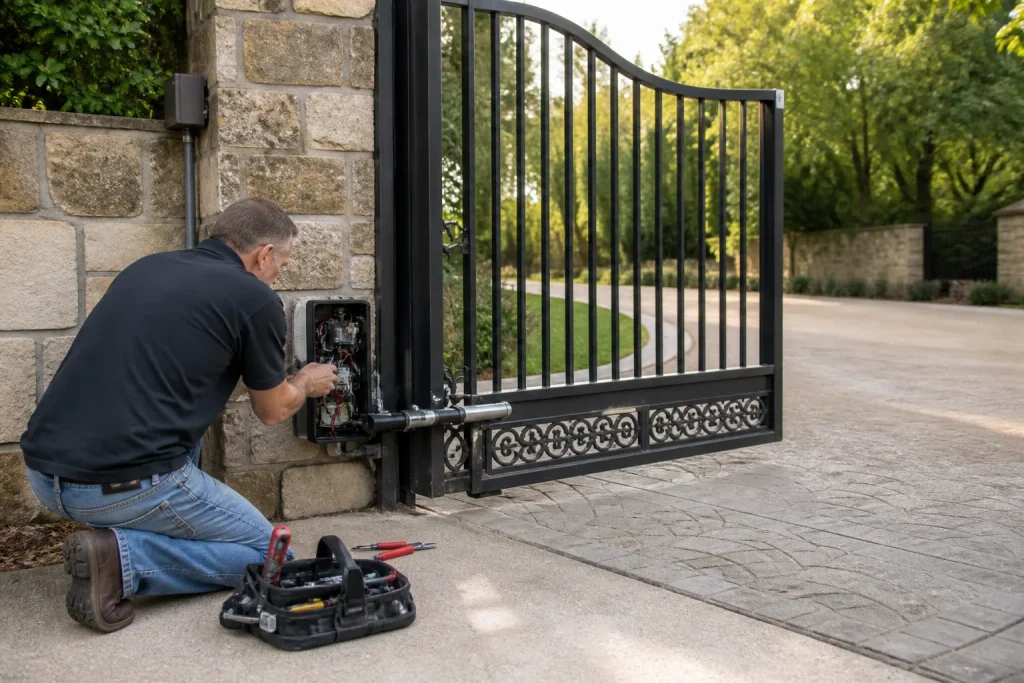
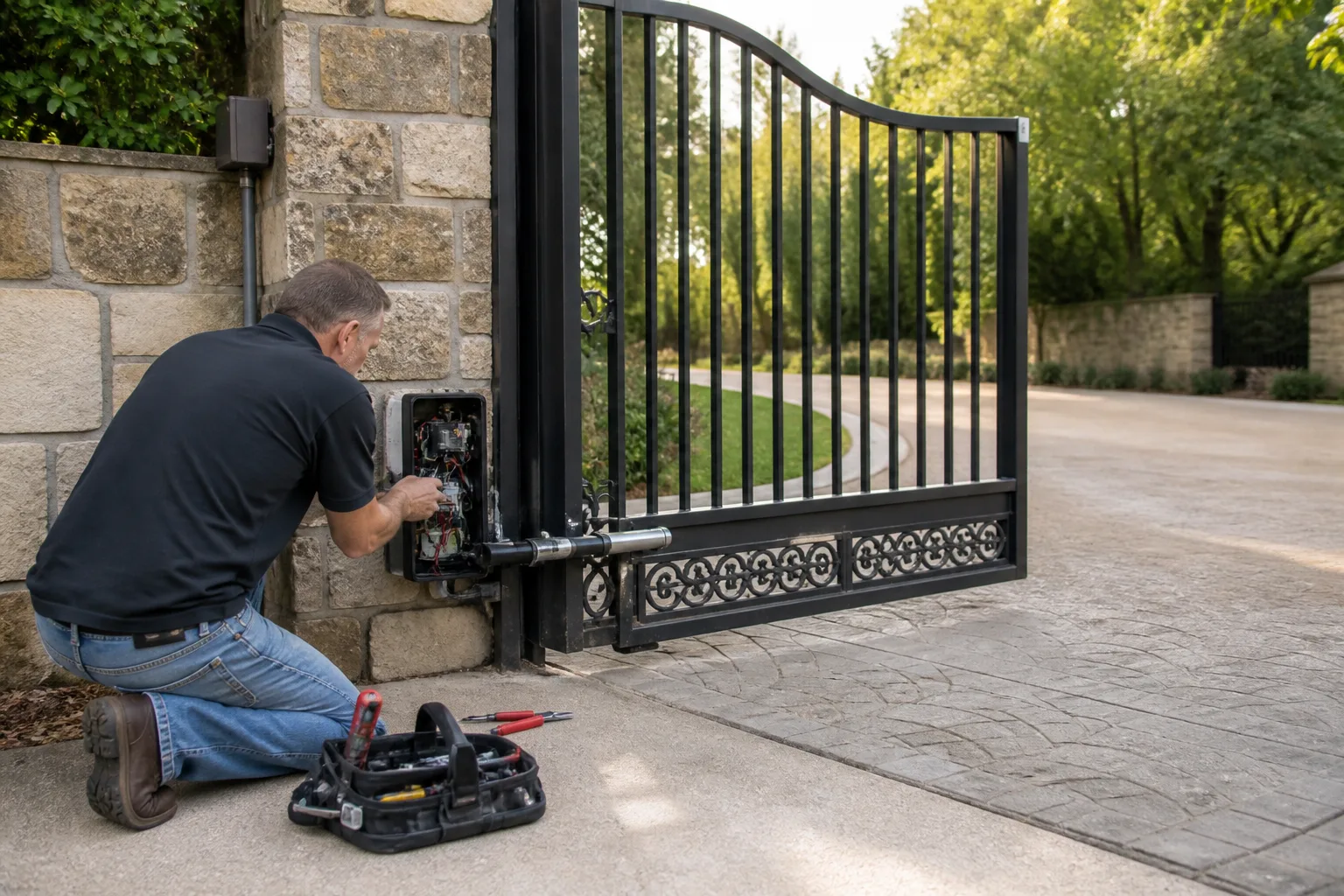
Emergency Gate Repair Near Me: What Pleasanton Homeowners Should Do First
If your gate just failed, stop before you touch anything. The first move is to identify which of three situations you’re in: stuck open, stuck closed, or moving erratically. Each has a different immediate response, and forcing the gate manually without disengaging the operator first is the number-one cause of control-arm damage that turns a $150 sensor problem into a $400 mechanical repair in Pleasanton. If you’d rather skip the diagnosis and get someone out today, call (833) 593-6440.
First: Stop Pushing. Forcing a Gate Is the Most Expensive Mistake
When a gate stops responding, the instinct is to shove it. Don’t. A gate stuck on its track isn’t waiting for more muscle. It’s waiting for you to release the operator so the arm, chain, or ram isn’t fighting you. Every push against an engaged operator puts load on the control arm, the gearbox, and the chain. We’ve seen a $40 limit-switch issue become a bent control arm because a homeowner leaned into the gate with a shoulder. In Pleasanton’s gated communities along Foothill Road and in the Ruby Hill area, those arms are often LiftMaster or FAAC rams that don’t tolerate lateral force well. The rule is simple: if it doesn’t move with a gentle nudge, don’t force it. Disengage first.
This is exactly the kind of thing we cover on our Gate Repair Pleasanton home page, but the short version is that every automatic gate has a manual release mechanism designed to let you move the gate without damaging the drive system. Finding it takes thirty seconds. Using it wrong takes ten. The next section walks through how to do it right.
How to Disengage Your Gate Operator Without Damaging It
Most residential gates in Pleasanton run on one of five operator types: swing-arm rams, sliding-gate chains, worm-gear slide operators, underground loop systems, or jackshaft openers. Each has a release in a different spot, and each release works a little differently. Here’s the direct answer for each common setup. Do not do this if the gate is mid-travel or on a slope without first blocking the gate wheels so it can’t roll once released.
- Swing-arm rams (common on FAAC, BFT, and Viking systems): Look for a small release knob or lever on the operator arm near where it mounts to the gate or post. Turn it counterclockwise or flip the lever to disengage the arm from the ram. The gate should now swing freely by hand, but it will be heavy. On a sloped driveway, have someone hold it.
- Sliding-gate chains (typical on LiftMaster and Elite slide operators): The release is usually a pull handle or a foot pedal on the operator housing near the ground. On LiftMaster slide units, look for a red or yellow pull lever on the front. One pull disengages the chain from the drive sprocket so you can push the gate along its track by hand.
- Worm-gear slide operators (DoorKing and some Linear models): The clutch release is a square bolt or a spring-loaded lever on the side of the operator box. Rotate the bolt a quarter-turn or lift the lever. The gear disengages and the gate rolls manually. Re-engage the same way before powering the system back on.
- Underground loop systems (less common in residential Pleasanton but present in some older estates): These don’t have an external arm to release. If the gate won’t open, do not pry at the hinge side. Call a gate specialist. The motor is buried and inaccessible, and digging around it without a locate can hit the service lines.
- Jackshaft openers (Mighty Mule and Ghost Controls units on chain-link and tube gates): The release is on the top of the motor unit: a small pull pin or a knob. Pull it and swing the lever down, which frees the drive shaft from the gate bracket. The gate will swing free. This is the easiest release of the five.
The point of disengaging isn’t to permanently convert your gate to manual. It’s to let you move the gate safely while you assess the situation. A gate that’s disengaged won’t respond to a remote or keypad until you re-engage it, so don’t leave it that way unless the gate can be secured in a closed or locked position. And if you don’t feel confident doing this, don’t. A dedicated gate technician can walk you through it over the phone in under two minutes, or come out and do it for you. That’s what we do on gate repair in Pleasanton calls every week.
Three Emergency Scenarios and What to Do in the First Ten Minutes
Your response depends on where the gate failed. Here’s the situational playbook for the three failures we see most in Pleasanton, from the flat streets of the downtown district to the hillside drives off Sunol Boulevard.
Scenario 1: The Gate Is Stuck Open
An open gate is a property security issue first and a mechanical issue second. In the first hour, before any technician arrives, your job is to restore a barrier. Here’s the order of operations:
- Disengage the operator using the release method above. If the gate rolls or swings manually to closed, push it there and secure it with a chain, a padlock, or a wedge at the base. Don’t re-engage the operator with the gate bound against something.
- If the gate won’t move manually, block the opening. A car parked across the driveway, a pair of saw horses, or a temporary chain strung between posts is not a gate, but it tells anyone scouting the property that the driveway isn’t a free pass.
- Kill power to the operator if it’s humming or clicking. A relay firing repeatedly against a stuck gate will cook a control board in hours. Flip the breaker or kill the switch on the operator housing. This is the step that saves a $600 control board.
- Call for service and tell them the gate is stuck open. That’s a different priority than a gate that just stopped opening. A stuck-open gate is a security triage call. Any gate company that treats it like a routine ticket doesn’t understand the job.
In Pleasanton, a gate stuck open on a property backing up to open space or on a corner lot matters more than one in a fully enclosed courtyard. Be honest about the exposure when you call. It changes what the technician packs.
Scenario 2: The Gate Is Stuck Closed
A closed gate is inconvenient but not a security emergency, unless you can’t get a car out and you need to leave. The first question is whether the gate is stuck mechanically or electrically. Try the keypad. Try the remote. Try the wall button. If nothing responds and the motor doesn’t hum, you likely have an electrical fault: a tripped breaker, a dead capacitor, a failed control board, or a short. If the motor hums but the gate doesn’t move, you have a mechanical bind: a bent track, a failed wheel, a stripped gear, or an arm that’s popped a retaining pin.
Your first move in either case is the same: disengage the operator so you can operate the gate manually if you need to leave. If the gate won’t move even disengaged, the problem is mechanical, and pushing harder is the wrong answer. Block it, don’t force it. If you can move it manually, get your car out and then decide whether to re-engage the operator or leave it disengaged and secured until a technician arrives. Do not re-engage an operator on a gate that only moves with difficulty. You’ll burn out the motor or strip the gear.
This is where brand familiarity actually matters. A Mighty Mule jackshaft stuck closed on a tube gate is usually a limit-switch issue, fixable in twenty minutes. A FAAC ram stuck closed is often a hydraulic fluid leak, which is more involved. Knowing which operator is on the post before you call means the technician arrives with the right parts and doesn’t burn a second trip charge.
Scenario 3: The Gate Is Moving Erratically
A gate that opens partway and reverses, opens on its own, or stutters mid-travel is the most dangerous of the three. This is an immediate safety concern, not just an access problem. An automatic gate that moves without a command or reverses unpredictably can hit a car, a pet, or a person. In Pleasanton, where gates front onto sidewalks and where kids walk to school along streets like Valley Avenue, an erratic gate is a liability waiting to happen.
The first action is to cut power at the breaker or the operator switch. Do not try to use the gate. Do not let kids or pets near the gate opening. Once power is off, the gate is dead and safe. Then call a gate specialist and tell them the gate was moving unpredictably. That’s a technician-first job, not a you-first job. The likely culprits are a failed safety sensor, a control board memory fault, or a feedback loop issue in the operator. On LiftMaster and Elite systems, we frequently trace erratic movement to a photo-eye knocked out of alignment by a landscaping bump or a sprinkler head that’s been spraying water into the sensor housing for months.
For electric gate failures specifically, electric gate repair in Pleasanton covers the full diagnostic process: motor, control board, safety sensors, and the remote or keypad receiver. The key point for this scenario is that you don’t stand there watching it and hoping it fixes itself. Kill the power. It’s the only move that can’t make things worse.
What to Have Ready Before You Call a Gate Repair Company
The difference between a technician who fixes your gate in one visit and one who has to leave and come back with parts is often the information you give on the call. Not the repair company’s skill. Your description. Here’s what to have ready before you dial:
- The brand name on the operator, if you can read it. LiftMaster, FAAC, Mighty Mule, Elite, BFT, DoorKing, Viking, Linear, Ghost Controls. It’s usually on a metal tag on the operator housing or on the control box. This matters because a technician who knows they’re walking up to a FAAC ram brings hydraulic parts. One who knows it’s a Ghost Controls unit brings a different set.
- What the gate did just before it failed. Did it open slowly? Did it make a grinding noise? Did it trip a breaker? Did it fail after rain or a power blip? These details are diagnostic gold. A gate that worked fine until Tuesday’s storm likely has a water-related short. A gate that’s been slowing down for two weeks is probably a bearing or gear issue.
- Whether it’s a slide or a swing. If you don’t know, describe it. “It slides along a fence” or “it swings like a door.” The operator type and the repair needs are completely different.
- How you normally open it. Remote, keypad, app, intercom, or all four. If the keypad stopped working but the remote still works, that’s a receiver or keypad issue, not a motor issue. If everything failed at once, that’s power or control board.
- The gate’s location on your property and how it’s accessed. Is it at the street, behind the house, up a steep driveway, or in a courtyard with no vehicle access? A gate on a steep driveway off Happy Valley Road takes different equipment than a flat street-front gate in the Vintage Hills area.
One more thing worth knowing: a recent photo of the operator taken with your phone and texted to the repair company is one of the most useful things you can send. It tells the technician the brand, the model, the approximate age, and often the failure mode before they leave the shop. We ask for one on every gate installation in Pleasanton quote and on most repair calls. It saves everyone time.
Which Emergencies Are Real Emergencies, and Which Can Wait Until Monday
Not every gate failure needs a 9 p.m. Sunday response. Here’s the honest triage, the same one we use when a Pleasanton homeowner calls in a panic and we’re deciding whether to roll a truck immediately or schedule for morning.
True emergencies, requiring immediate professional response:
- A gate that moves on its own or reverses mid-travel. This is an injury risk. Kill the power, call now.
- A gate stuck open on a property where the gate is the only barrier between the street and the house, especially at night or when the home will be unattended.
- A gate arm or chain that has broken and left a heavy gate resting precariously on one hinge, one wheel, or against a fence. If that gate falls, it can damage a car, a fence, or a person.
- A gate that has come off its track and is leaning into a sidewalk or public right-of-way.
Not emergencies, though still worth fixing quickly:
- A keypad that stopped working, while the remote still opens the gate.
- A gate that’s slow but functional.
- A remote that needs reprogramming.
- A gate that only opens when you hold the button down.
- A gate that’s stuck closed on a property with a second exit or no urgent need to move vehicles.
One real-world example from last month: a homeowner in the Ruby Hill area called at 10:30 p.m. because their gate wouldn’t open. It was stuck closed, but they had a second driveway gate on the other side of the property and no emergency exit need. We scheduled for 8 a.m. the next morning, walked them through disengaging the operator over the phone so they could use the gate manually if needed, and saved them an after-hours dispatch charge. The fix took twenty minutes the next day: a failed capacitor on a LiftMaster slide operator. The point is that a good gate specialist doesn’t just take the call. They tell you the truth about whether you need them in the next hour or the next business day.
Why Gate Brand Experience Actually Matters in an Emergency
You don’t need to care what brand your gate operator is, until the moment it fails and you’re reading the model number off a housing in the dark. Then it matters a lot. Each brand has its own failure patterns, its own control board quirks, and its own parts. A technician who knows Elite slide operators knows they have a specific limit-switch assembly that fails in a particular way. A technician who only works on one brand is going to misdiagnose a Viking or a BFT.
We made the decision years ago to work across the major brands: LiftMaster, FAAC, BFT, Linear, Viking, Ghost Controls, DoorKing, Elite, and Mighty Mule. That’s consumer-grade openers up to commercial access systems, residential to commercial. It’s the reason we stock a wide range of parts on the truck and why our diagnostic process starts with identifying the operator architecture before touching anything else. Brand-agnostic diagnostics mean we find the actual fault, not just the easiest replacement sale. In Pleasanton, where gates range from Mighty Mule units on chain-link tube gates to professional FAAC rams on estate entrances, that range matters. A general handyman who “also does gates” doesn’t carry a BFT control board. A gate specialist does.
For a deeper look at how electric gate systems fail and what’s involved in fixing them properly, see our electric gate repair in Pleasanton page.
The Bottom Line
The ten minutes after a gate failure determine whether you’re dealing with a small repair or a replacement. The sequence matters: don’t force the gate, identify the failure mode, disengage the operator if it’s safe, cut power if the gate is moving unpredictably, and call with enough information that the technician arrives ready. A stuck-open gate is a security issue. A moving-on-its-own gate is a safety issue. A stuck-closed gate is usually manageable for a day or two. Know which one you have, and act accordingly.
If you’re in Pleasanton and need someone to look at it, we’d rather talk you through the disengage step on the phone than have you force a gate and turn a simple fix into a control-arm replacement. Call (833) 593-6440. Estimates are free, and we’ll tell you straight whether it’s an emergency or a Monday-morning job. If you need a new gate or a full system replacement, we handle gate installation in Pleasanton too, so the diagnosis and the fix stay under one roof.
Frequently Asked Questions
Emergency gate repair in Pleasanton typically runs $150 to $400 for the service call and labor, with parts additional depending on the operator. A failed capacitor on a LiftMaster slide unit might be under $200 all-in. A FAAC hydraulic ram repair or a control board replacement can run higher. The price is quoted and agreed before any work starts, so there’s no surprise on the invoice. Call (833) 593-6440 for an exact quote. Estimates are free.
Yes. Disengage the operator, push the gate closed, and secure it with a chain, padlock, or wedge. If it won’t move manually, block the opening with a vehicle or a temporary barrier. Killing power to the operator is important if it’s humming or clicking, because that protects the control board. Then call a gate specialist in the morning. The security exposure is why a stuck-open gate is treated as a higher priority than one stuck closed.
In Pleasanton, older estate properties often have FAAC or Viking hydraulic rams, while newer residential gates commonly use LiftMaster slide operators or Mighty Mule and Ghost Controls jackshaft units on tube gates. Commercial and HOA access points often run BFT or DoorKing systems. We service all nine major brands, so the one on your property is one we’ve worked on before.
If the gate is moving on its own, yes. Cut power immediately at the breaker or the operator switch. A gate that reverses or opens without a command is a safety hazard. If the gate is simply stuck and not doing anything, killing power is also fine and protects the control board from a relay firing repeatedly. You can restore power when the technician is on site.
Written by the team at Gate Repair Pleasanton, serving Pleasanton since 2016.
Need Gate Repair Help?
Call Gate Repair Pleasanton - licensed & insured, here with fast help in Pleasanton.
(833) 593-6440